About
The United Nations World Food Programme (WFP) is the world’s largest humanitarian organization addressing hunger and promoting food security.
WFP works in over 100 countries and territories, delivering food assistance in emergencies and partnering with governments to strengthen national capacities for long-term food systems resilience.
This platform showcases WFP’s commitment to SSTC as a key pathway for countries to share experiences, technologies, and solutions that accelerate progress toward ending hunger and to reach the most vulnerable.


Leave No One Behind
Leave No One Behind
WFP engagement in SSTC will benefit those most at risk of being left behind (such as women and girls, persons with disabilities, indigenous peoples, minority language speakers and those with multiple, intersecting needs) and their communities.

Women's Rights
Women's Rights
SSTC brokered and facilitated by WFP will consider the equal rights of girls, boys, women, and men, ensuring access to services, opportunities, and resources.

Country Ownership
Country Ownership
WFP will facilitate SSTC at the national, subnational, and community levels, responding to country demand and anchoring support in national policies and programmes. People have decision-making power and ownership over processes, ensuring a right to food and the ability to express their priorities regarding local solutions.

Added Value
Added Value
WFP engages in SSTC when it can add value through its networks, expertise, visibility, global reach, cost-effectiveness, and operational capacity, ensuring a high return on investment and results at scale.

Innovation
Innovation
WFP supports countries in sharing innovative practices as well as in co-creating solutions to country priorities that are inclusive, sustainable, and responsive to their needs and circumstances.

Strengthening Country Systems & Capacity
Strengthening Country Systems & Capacity
In facilitating SSTC, WFP focuses on strengthening national systems and institutions.

Activities

Drive Policy
Drive Policy
Drive change at the policy level by incentivizing policymakers to prioritize investments in zero hunger through generating evidence, advocating, and giving exposure to other countries’ experiences.

Provide Technical Support
Provide Technical Support
Empower experts at the technical level expanding the skills and capacities of national experts to design and implement inclusive and gender-transformative food security and nutrition programmes through training, technology transfer, peer learning and joint problem solving.

Scaling Innovations
Scaling Innovations
Scaling up innovations at grassroot level by testing what works and what doesn’t in the field, facilitating joint problem analysis, peer coaching and farmers-to-farmers exchanges to build resilience and improve the nutrition of people and communities affected by the protracted crisis while leveraging WFP’s Innovation Accelerator.
Advantages
Strong field presence and operational capacity
Strong deep field presence and direct access to grassroot level in over 100 countries to enable the most vulnerable to benefit from SSTC initiatives and strong operational capacity of delivering as an effective and reliable partner in some of the world’s most difficult places, including conflict-affected countries, to ensure effective and timely operationalization of SSTC activities on the ground.
Global outreach
Global outreach and a proven ability for a rapid and scalable response. As the largest humanitarian and development UN organization with more than 152 million people assisted globally, and with over a decade of experience in facilitating SSTC, WFP is uniquely positioned to support countries to successfully scale up innovations from the Global South.
Knowledge of local contexts
Direct knowledge of local contexts to identify relevant needs/offers, enable effective matchmaking, and facilitate solutions adaptation in recipient countries.
Trust
Trust by host governments and donors as partners for tackling hunger and malnutrition challenges in some of the world’s most difficult places and conditions; and sustainable partnerships.
Wide network
Network of Centres of Excellence in Brazil, China and Côte d’Ivoire that leverages an institutionalized relationship with key SSTC provider countries to support providers’ engagement in SSTC while increasing their visibility and helping recipient countries to tap into the expertise of the world’s largest SSTC providers.
Innovative approaches
Focus on innovation (technologies and digital SSTC business models) to support provider countries in packaging their solutions while helping recipient countries test/adapt new solutions from the Global South.
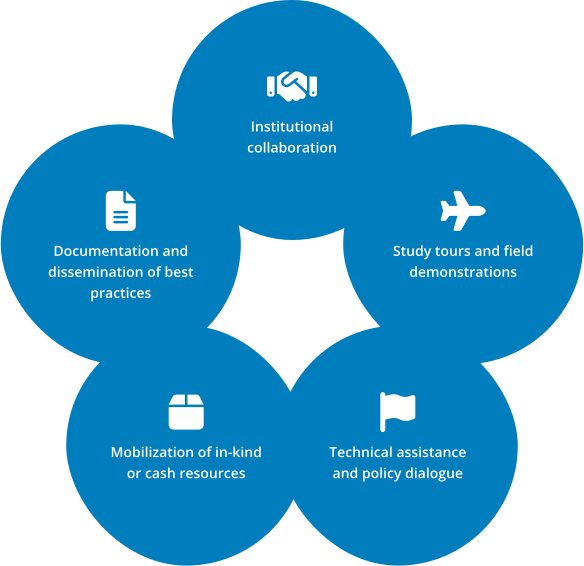
We tailor each engagement to country needs, to support national priorities and aligned with WFP’s Country Strategic Plans.

The 2021 evaluation of WFP’s policy on SSTC recognized the significant growth of WFP’s work on SSTC, and recommended actions to expand and improve the effectiveness of the SSTC portfolio. One of the key recommendations was to update the WFP’s SSTC policy in 2023 to better reflect WFP’s strategic development, the changes in the international context as well as the growth and achievements of WFP’s work in SSTC over the past seven years.
The development of 2023 SSTC policy involved extensive consultations with over 300 WFP stakeholders across all levels, with a significant involvement of country level leadership and staff. The updated policy provides a robust and evidence-based account of WFP’s SSTC engagement and results. Please see the WFP SSTC Policy here.
WFP is not only supporting the strengthening of national capacities but also catalyzing country-owned investments in hunger solutions—moving from aid to ownership of solutions, and from pilots to policy.